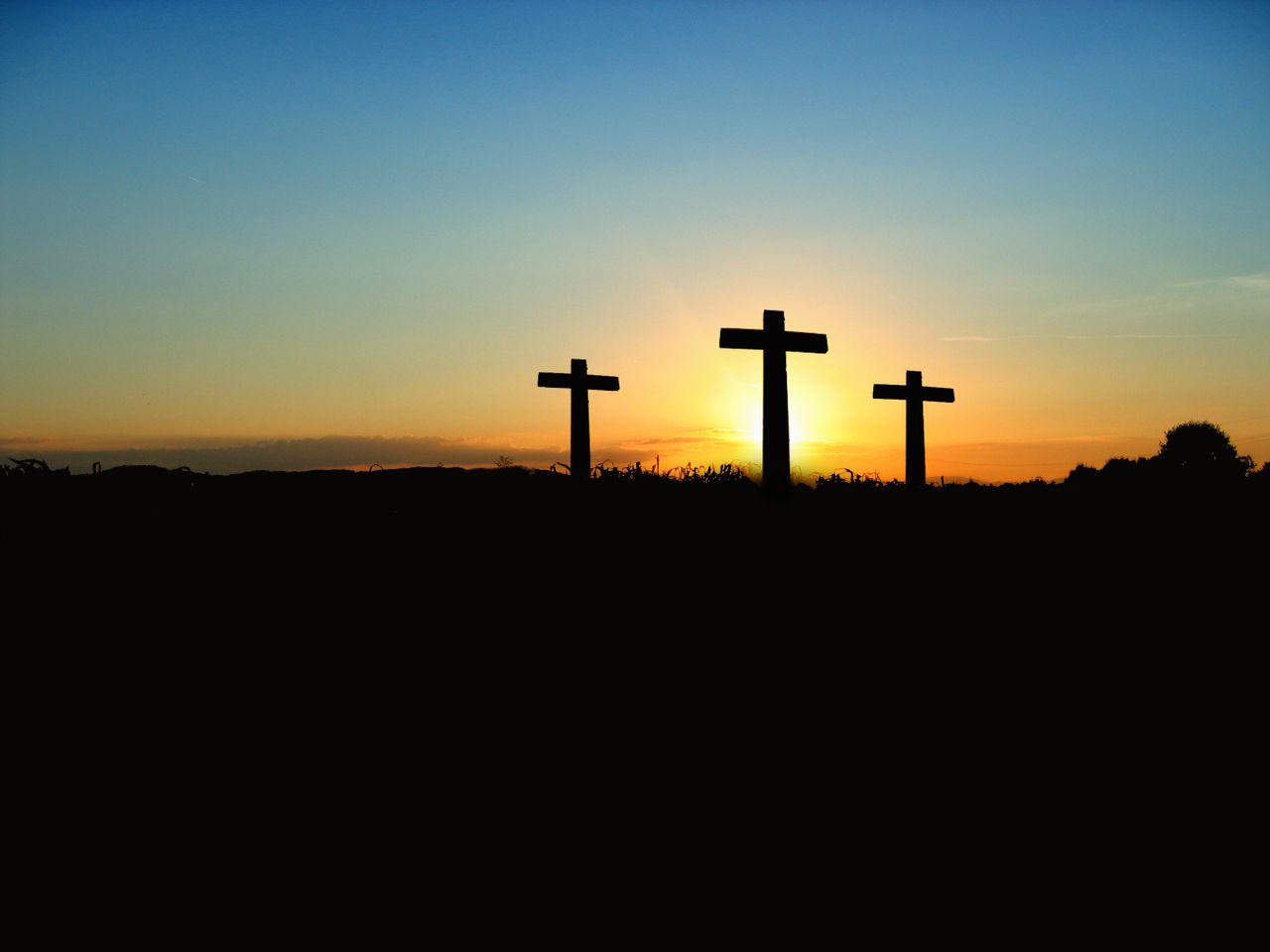
In the Pagan community, a large segment of the population of which either converted away from Christianity or have a direct family member who did so, it is extremely controversial to say that you work with Christian mythology. It simply is not accepted, which is why speaking as a practitioner who incorporates some Christian mythology into their personal practice is difficult to impossible. I have experienced a few different types of reactions:
- “Oh, so you’re a Christopagan. That’s cool. You’ll find your path eventually.”
- “You can’t be Christian and Wiccan/Pagan at the same time!”
- “Go back to church! Don’t come into Pagan space with that energy!”
The first reaction is dismissive disguised as accepting, as if being a Christopagan isn’t a legitimate form of Paganism but rather a halfway point for new practitioners to play in while they find their “real” Pagan path. I’m not arguing for or against it here, since I don’t identify as Christopagan. I simply don’t have a dog in that fight. But this reaction tells me that the person speaking has already decided they know everything there is to know about why I choose to work with the Christian deities, saints, and heroes and isn’t interested in or curious about my practice in the way that they might be Norse Paganism or Hellenic Paganism or Celtic Paganism. The door can’t be opened because it was never unlocked to begin with. To these folks, I usually shrug and say, “I’ve been on the path for 25 years. I think I know what I’m doing.”
The second reaction is usually hostile but sometimes an invitation to a debate that there’s no way to win, which ultimately is its own kind of hostility. I do not identify as Christian. I have complicated feelings about my baptism, since I was baptized as a young child, and my confirmation as an adult “didn’t take” from a magickal/energetic standpoint (and one day I’ll write a detailed essay on that experience). I reject some key parts of both the Apostles’ Creed and the Nicene Creed. I haven’t participated in the Eucharist for years. If I were a Christian, I would be a heretic at best and an excommunicant at worst. But I am not a Christian. I am a Wiccan — very specifically an initiate of a traditional line of the Craft — who agrees in principle with the teachings of Christ and has ancestral connections to a few specific denominations of Christianity as well as a desire to honor those connections and folkways in their practice. But again, these folks have already decided on the definitions of “Christian” and “Pagan” as mutually exclusive terms and it would be difficult to get them to re-define those terms for the sake of a single conversation. Once again, the door can’t be opened because it was never unlocked to begin with. To thse folks, I usually respond with a simple “agree to disagree” and move on.
The last reaction is one that I had myself as a younger witch. I believe it’s part of the psychological separation phase where someone has left one religion and is practicing another but has not yet made peace with their experiences in their past religion so they judge everyone by the same traumatized standards that they judge the people in their familial/cultural religion. By acting as a defender of “Pagan space” or the “Pagan community” by keeping the evil, abusive, patriarchal, money-loving, insert-other-stereotypical-complaint-here Christians out, they slam closed doors that could open them toward making peace with Christianity, which I have concluded most people don’t want to actually do. They need an adversary to make themselves the hero of their own spiritual journey. Some people need to have a persecutor in order for their spiritual path to have worth to them. And that’s alright. That’s their path. And I am not a Christian so it’s not my spiritual duty to evangelize to them or anybody else. Ultimately, these folks get a shrug and a funny look as I walk away and go about my business.
So what does my practice look like? Mostly like any other conventional Pagan practice. I observe the Wheel of the Year, but I also remember that as a post-Christian religion, Wicca has taken (or some would say taken back) many of its symbolic associations from Christianity. I celebrate the full, dark, and waxing crescent moons (what my tradition calls the liturgical new moon to differentiate it from the astronomical new moon). I celebrate a few astronomical and astrological phenomena, such as the eclipse cycles and the astrological cross-quarters. I have a personal calendar of observances devoted to individual deities, saints, and heroes, so I give offerings to those entities at those times. My personal devotional deities are of Welsh origin, so I honor them regularly with offerings, but I have significant relationships with Isis, Aradia, Cernunnos, and some other deities I won’t mention out of respect for the traditions that venerate them. (This goes back to what I was saying in my previous article about not inserting myself into discussions where I as a White person would devalue and decenter the marginalized populations that should rightly be centered and amplified in said discussions.)
My particular practice is founded on ancestor veneration, so acknowledging Christianity as part of my native culture is important to me. Understanding the liturgical calendar and the customs associated with the seasons is one of the ways that I keep in touch with those ancestors. But I have Pagan customs as well — and Pagan ancestors that I share a spiritual heritage with — so I blend those in on as equal a footing as I can depending on the time of year.
I have a devotion to St. Benedict in his roles as both a monastic leader and an exorcist, and so I incorporate aspects of the Rule of St. Benedict into my daily practice. I also recall him on his feast day and ask for his intercession in certain matters. Similarly, I have relationships with the Blessed Virgin Mary (and have since I was seven years old), St. Michael the Archangel, St. Thomas Aquinas, St. Hildegard of Bingen, and St. Joan of Arc. I have prayed Rosaries in honor of these saints and lit novena candles to petition them, just as I commune with my Pagan deities through offerings and meditation. In my mind, it’s no different than calling upon any other spirit or entity.
None of this means that I focus on Christian traditions to the exclusion of Pagan ones. In fact, I try to keep them as balanced and equal as possible. But there are times when dealing with a situation calls for a focus on one over the other. For example, when I work magick for my father’s health, I call upon St. Luke and St. Jude because those are the entities he has a connection to. Working with Pagan deities would be inappropriate and an offense to him, so I won’t do it. But for my daughter, who is interested in the Craft and would be open to the blessings of the Goddess, I typically call on Aradia or Ceridwen when I work for her.
When I teach, I focus on the Pagan lore that I’ve learned. I don’t expect any of my students to have the same relationship with Christianity that I do, and I think that’s a very important distinction. Just because some of my personal power comes through my relationship with Christian entities does not mean that I push that onto others. If people want to explore Christianity as a Pagan practitioner, I’m happy to give pointers and share my experience, but I’m not an evangelist. I’m not going to insist that people do things a certain way, but I do try to encourage people to make peace with and define their relationship with Christianity since a significant segment of the Pagan population has an ancestral or personal connection to it.
I like to think that my path isn’t as uncommon as I tend to feel like it is and that a good percentage of Pagan practitioners have beliefs in Christianity that they don’t want or don’t know what to do with. But due to the stigma associated with incorporating Christian or Christian-influenced practices into Paganism, I feel like those people keep those feelings, beliefs, and aspects of their practice quiet for fear of being marginalized in Pagan spaces. This article and others in its series are my hopeful attempt to dispel some of that stigma while maintaining the integrity of Paganism as a distinct spiritual path. It is my hope that it is received in the spirit with which it was written.